The phone on your kitchen wall hasn't changed. Same handset, same cord that's been twisted into a knot since about 2011, same dial tone when you pick it up.
The bill has changed. In February 2020, AT&T's price sheet for a basic California home line listed $27 a month. The February 2026 sheet says $50. Want Caller ID with that? $13.99 more. Call Waiting? Another $13.99. Long distance included? That package is $99.50.
Nobody sent you a new phone. Nobody ran new wire to your house. The only thing that got upgraded was the invoice.
Here's why that happened, in California and four other states, and what a home phone should actually cost in 2026.
The Price Sheet, Then and Now
California requires AT&T to publish its home phone prices every year, which makes it the clearest public record of what's happened to the plain old landline. Basic flat-rate service, unlimited local calls, one line:
- 2006: $10.69
- 2009: $16.45
- 2013: $23.00
- 2020: $27.00
- 2024: $37.50
- 2026: $50.00
Those prices are before taxes, fees, Universal Service charges, and the Federal Subscriber Line Charge, all of which get added on the way to your mailbox. The activation fee is $49 if you're starting fresh.
The features climbed too. Caller ID went from $10.99 to $13.99 a month in six years. The "All Distance" package, which bundles the line with long distance and a dozen features, went from $66 to $99.50 over the same stretch. Even the discounted LifeLine rate for low-income households nearly tripled, from $8.48 to $25.
It's Not Just California
Illinois
In 2010, Illinois law required AT&T to offer a bare-bones unlimited-local plan for $9 to $15 a month, and froze the price. AT&T lobbied that requirement out of the state's 2017 telecom rewrite, and in 2022 paid a $23 million federal fine over bribery connected to passing that law.
The replacement plan cost $20.75 a month at the end of 2021. AT&T's own Illinois price guide, effective March 1, 2026, lists it at $46.75. A plan that gives you just 30 local calls a month now runs $42.25 to $46.75. And the letters have gone out: copper service in Illinois ends "on or after March 15, 2027."
Texas
Texas ended state oversight of basic rates in 2011. AT&T's Texas guidebook now lists a plain residential line at $58 a month, a figure marked as a fresh increase in January 2026, and $66.95 for the extended-metro version that many suburban households around Dallas, Houston and San Antonio carry. New customers haven't been able to order the service since October 2025. For scale, AT&T's own website advertised unlimited local landline service for about $30 a month in 2013.
Florida
Here the biggest landline company isn't AT&T. It's CenturyLink, which inherited the old Sprint territory around Orlando, Tallahassee and Fort Myers and which the Public Service Commission has named Florida's largest residential landline provider year after year. Florida also went furthest on deregulation: the 2011 Regulatory Reform Act eliminated rate caps and the commission's consumer-protection role in one stroke, so unlike California there is no official price sheet to quote.
CenturyLink's flat-rate home phone is currently listed at about $50 a month, with a rate guarantee that lasts twelve months and nothing after that. In Utah, one of the states where its parent Lumen still has to file its prices, the company raised residential line rates in 2021, again in early 2025, and added another $2 a line that November. What Florida's commission still counts is customers: the state had 12 million landlines two decades ago and 764,000 in 2023, with residential lines down 22 percent in that one year.
New York
Verizon's copper customers have watched the "dial tone" line on their bills climb since state regulators approved back-to-back increases in 2008 and 2009 to shore up the company during its fiber buildout. A 2014 petition to the commission calculated that New York City residential dial-tone service had risen 84 percent since 2006, while inside-wire maintenance rose 132 percent. Today Verizon's residential rates fall under what its tariff calls "Full Flex," meaning the company sets them. A standalone copper line is hard to even order; home phone is now sold as a roughly $30 add-on to a Fios internet plan, which puts the realistic floor for a New Yorker who just wants a phone at about $80 a month.
Five states, five regulatory histories, one direction.
Why It Keeps Going Up
For most of the 1990s and 2000s, states capped the basic rate. In California it sat at $10.69 for years. Then, one legislature at a time, the caps came off: California in 2006, Texas and Florida in 2011, Illinois in 2017. The theory was always the same. Cell phones and internet calling would give people so many choices that the market would keep prices honest.
That isn't how it went. Within six years of California's decision the basic rate had more than doubled. The CEO of a competing internet provider described AT&T's strategy at the time as "harvesting": raise the price on the customers who stay, because the ones who leave mostly end up on AT&T's cell service anyway.
There's also plain arithmetic. Copper phone lines are expensive to keep alive, and AT&T has said it spends about $6 billion a year maintaining them. Every year, fewer households share that cost. The customers left on the line, disproportionately older, rural, or simply loyal, pick up a bigger slice each time a neighbor cancels.

See what your phone bill should cost
Get a quote in about a minute. Keep your number, keep the phone on the wall, and see how much you'd save by switching.
The $13.99 Caller ID Problem
Look at the feature list on that California price sheet and you'll notice something. Almost everything costs $13.99 a month. Caller ID, $13.99. Call Waiting, $13.99. Three-Way Calling, $13.99. Call Forwarding, $13.99.
And then there's "Call Screen," which blocks up to ten phone numbers of your choosing. Also $13.99 a month.
Ten numbers. In a year when Americans received 3.9 billion robocalls in a single month, most of them from numbers that change daily, the phone company will sell you the ability to block ten of them, for the price of a streaming subscription.
This is the part that stings. The features that actually matter in 2026, seeing who's calling and keeping the junk from ringing, are the ones priced as luxuries on a copper line. On a modern home phone service they're simply how the phone works.
What You're Actually Paying For
Not the features. Not the phone. You're paying for the wire.
Federal statisticians tracked this for years: between 2009 and 2015, the price index for landline service rose 14 percent while wireless service fell 13 percent and prices overall rose 10 percent. Landlines were the one piece of the phone bill going the wrong direction, and they've kept going.
It's worth sitting with that for a second. The service is identical to what it was in 1995. It hasn't gotten faster, clearer, or safer. Your neighbor's cell plan added unlimited data and international texting over the same period and got cheaper. Your landline added nothing and doubled.
The Bill Isn't the Only Thing Going Away
Here's the twist for anyone thinking they'll just ride it out. The $50 line has an expiration date.
AT&T has told federal regulators it plans to retire the large majority of its copper network outside California by the end of 2029. Illinois customers have a date in writing: March 15, 2027. Texas stopped taking new landline customers last October. Customers in other areas were notified that service could be discontinued starting November 15 of this year. In California, the company has FCC approval to start phasing out copper on June 1, 2027, affecting an estimated 184,000 homes.
So the price is going up on a service that's being switched off. You'll be asked to move to something else regardless. The only question is whether you pick the something else or have it picked for you.
Check coverage at your parents' address
Home phone service for $7.46/mo. Keep their existing number, and nothing changes for them except the bill. Setup takes 15 minutes.
or call an expert 24/7 - (844) 843-4175
What a Home Phone Should Cost in 2026
Run the numbers on the copper line the way most people actually use it: the basic rate, Caller ID so you can see who's calling, and Call Waiting so you don't miss your daughter while you're on with the pharmacy. In California that's $50, plus $13.99, plus $13.99, before a single tax or fee. Call it $78 and change. In Texas the line alone is $58. In Illinois it's $46.75 for local calls and nothing else. In Florida, CenturyLink's flat-rate line is about $50.
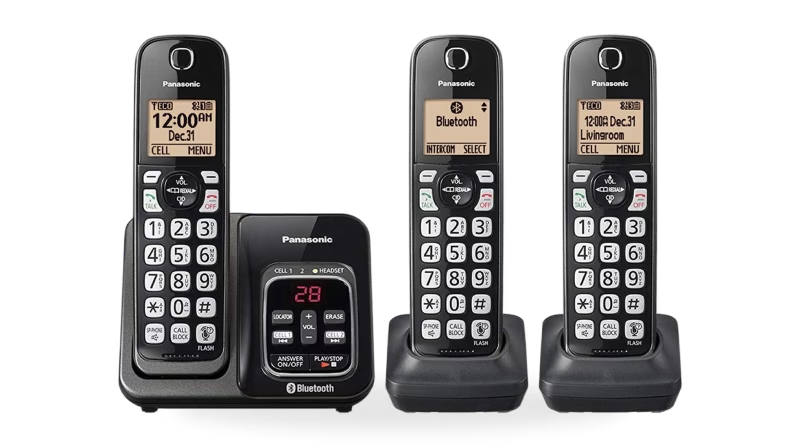
A modern home phone service runs over your internet connection instead of copper, and the difference shows up on the bill immediately. Unlimited calling in the U.S. and Canada, Caller ID, and call screening that blocks scam and spam calls automatically come standard, for $7.46 a month. You keep your phone number. You keep the phone on the wall; a small free adapter plugs in between the phone and your router. Setup takes about fifteen minutes and there's no contract.
The average customer who makes the switch saves around $380 a year. On the price sheets above, the math works out to considerably more than that.
The dial tone sounds exactly the same. That's the point. It's the same phone call it always was. It just stopped costing $50 a month to hear it.
Video
Same dial tone. A fraction of the bill.
Switch to Voiply for $7.46/mo, keep your number, and save around $380 a year. Check coverage and get your quote in under a minute.
or call an expert 24/7 - (844) 843-4175
MONEY BACK GUARANTEE

Blocks spam & scam calls automatically
Keep your existing number
Works with your current phone
Free adapter, free shipping
No contract, cancel anytime
Unlimited calling in US & Canada
or call (844) 843-4175