
Shopping for home phone service in 2026 can feel more confusing than it should be. The phrase "home phone service" covers four distinct technologies that work differently, vary in cost, and stop working in different situations. Most people pick a provider before realizing they're comparing things that aren't really equivalent, then wonder why the experience doesn't match their expectations.
Let's look at what's actually available in 2026, who each type works best for, and what to know before you choose.
One Label, Four Different Technologie
The biggest shift in home phone service over the past decade isn't the price or the features. It's that the underlying technology has splintered into four separate categories. Understanding which one you're buying changes every other decision.
Here are the four available types of phone service:
- Traditional copper landlines
- Cable company digital phones
- Standalone VoIP
- Wireless cellular home phones
Each has a different infrastructure, a different monthly cost range, and a different answer to the question, "What happens when the power goes out?"
Traditional Copper Landline
A traditional copper landline sends calls over physical wires running from a telephone exchange to your home. It's the technology that most households used for most of the 20th century, and its defining characteristic is that it doesn't depend on your internet connection or household power to function.
That reliability has always been copper lines' main selling point. Traditional copper landlines historically continued working during power outages because they carried power from the telephone network itself, though reliability can still depend on local infrastructure conditions. Some copper deployments still rely on neighborhood equipment with backup power limitations.
The trade-off is cost and availability. AT&T, one of the last major carriers still offering copper-based residential service, currently offers plans priced mostly between roughly $58 and $72 per month, depending on the features included. Long-distance calls and features like call waiting are often charged separately on lower-tier plans.
AT&T also now offers copper service in only 21 states, and the company has been actively migrating customers away from copper infrastructure as it phases out the technology. CenturyLink, operating as Lumen in many markets, also offers copper service in select areas, though coverage and pricing vary significantly by region.
Best for: Households that need a phone that works during extended power outages and have no reliable backup for internet-dependent services. Not a practical option in most of the country, given shrinking availability and high monthly costs.
Cable Company Digital Phone
Cable companies, including Xfinity, Spectrum, Cox, and Verizon Fios, offer a home phone as an add-on to their internet or TV service. Despite often being marketed alongside traditional landlines, these are digital phone services delivered over the internet rather than copper wire. They require an active internet connection from the same provider.
Xfinity's Voice Premier plan starts around $40 per month when bundled with an Xfinity internet plan, and it includes unlimited calling to more than 90 countries. Verizon Fios offers a phone add-on for around $30 per month, but only for customers who already carry a Verizon internet or TV subscription, bringing the minimum total to roughly $80 per month. Spectrum and Cox offer similar bundle add-on structures with pricing that varies by market.
The practical advantage here is simplicity if you're already a cable internet customer. Adding a phone line to an existing account is straightforward, and a single provider handles your bill for both services. The limitation is that you're tied to that provider for both. If your internet goes down, your phone does too. Most cable digital phone setups also stop working in a power outage unless you purchase and install a separate battery backup unit. Internet providers may also not offer all the features available through other providers.
Best for: Households already paying for cable internet from one of these providers who want to consolidate their bill and aren't concerned about phone service during power outages.
Standalone VoIP
Voice over Internet Protocol, or VoIP, routes calls over your existing home internet connection. Unlike cable company digital phones, a standalone VoIP home phone service works with any internet provider. You don't have to switch your internet service to use it.
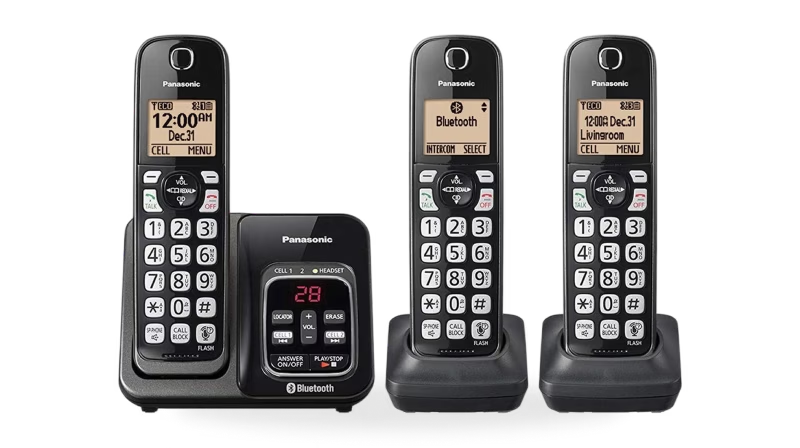
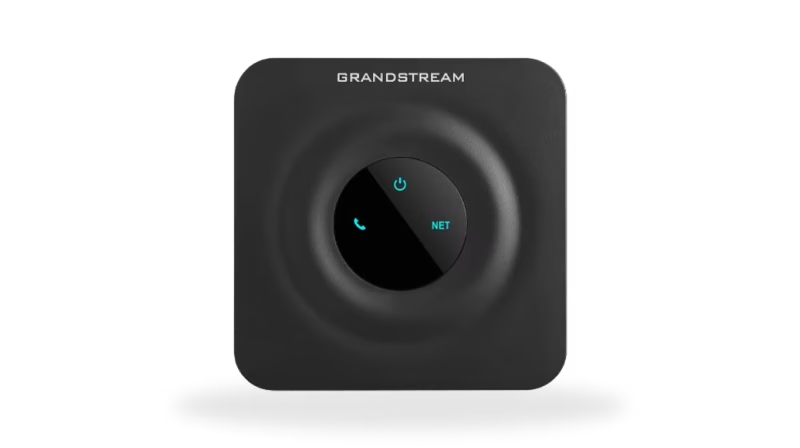
Setup is straightforward. A small adapter ships to your home pre-configured, you plug it into your router and plug your existing handset into the adapter, and your phone works within minutes. No technician visit, no new equipment to learn, and no change in how you actually use the phone.
Voiply is one of the most affordable options in this category, with residential plans starting at under $10 per month. The service includes caller ID, voicemail-to-email, call forwarding, and Robocall Defender, which became available free to all customers in early 2026. Voiply is BBB-accredited with an A rating and serves over 50,000 customers across the U.S. and Canada, with flexible plan terms of three months, one year, or three years.
Ooma is another option in this space. The Ooma Basic plan is free after purchasing the Ooma Telo device, which typically costs around $100. It includes voicemail, caller ID, and call waiting, with a limit of 5,000 minutes per month for residential use. The Ooma Premier plan adds features like call forwarding, three-way calling, and Canada calling for $9.99 per month. Ooma charges a separate $39.99 fee to port an existing number, which should be factored into the cost of switching.
Both services require a working home internet connection and will stop working if that connection goes down. A battery backup for your internet router can extend availability through short or moderate power outages. That lets you keep your phone and internet service during an outage, as long as the backup battery lasts.
Best for: Anyone with reliable home internet who wants an affordable, plug-and-play home phone service and a full feature set without paying for a cable TV or internet bundle they may not want.
Wireless Cellular Home Phone
Wireless home phone services run on the cellular network rather than the internet or copper infrastructure. You get a base unit that acts like a cell tower connection in your home, and your regular handset plugs into it the same way it would plug into a cable or VoIP adapter.
The appeal is that this type of service doesn't require a home internet connection. It works in rural areas where broadband is unavailable or unreliable, and the base units typically include a battery backup that keeps the phone running for a significant period during a power outage.
Community Phone uses cellular networks like T-Mobile to deliver service and offers plans starting at around $36 to $40 per month. The base unit includes a 26-hour battery backup, and Community Phone offers a multi-year price lock option that can provide cost certainty for customers on a fixed income.
Consumer Cellular is another option in this category. Plans start around $20 per month, and they have a partnership with AARP that includes a discount for members. Call quality with any wireless home phone depends on cellular signal strength at your specific address, so coverage is worth checking before you sign up.
Best for: Households without home internet, rural addresses with inconsistent broadband, or anyone who specifically needs a home phone that continues working during power outages without purchasing separate backup equipment.
What Every Plan Should Include
Regardless of which technology type you choose, some features should be included in your plan at no extra charge. If a provider charges separately for any of these, make sure to factor them into the monthly cost.
- Caller ID with full name display has become more important as robocall and phone scam rates have continued to rise. Knowing who's calling before you answer is a basic protection measure, not an optional upgrade.
- Built-in robocall blocking at the service level, rather than number-by-number blocking on the handset, is the more effective approach and is now standard among the better providers.
- Voicemail makes messages easier to manage and share, especially if it's delivered to email as an audio file.
- Call forwarding gives you flexibility when you're away from the phone.
One compliance note specific to VoIP and wireless home phones: E911 emergency calling works differently than it does on a traditional copper line. Your provider routes emergency calls based on a registered service address on file. That address should be set up when you activate service and updated any time you move, even temporarily.
VoIP and wireless home phone services are not guaranteed substitutes for traditional landline service in all emergency situations, but they support emergency calling reliably when the address registration is current and correct. Emergency calling availability may be affected by power outages, internet disruptions, cellular coverage limitations, or depleted backup batteries.
Matching the Right Service to Your Situation
The right choice usually comes down to four questions.
- Do you have reliable home internet? If not, wireless cellular is the practical answer. If yes, standalone VoIP offers the lowest cost and most flexibility. This doesn't mean you have to have the fastest internet available if you want to pursue other options. As a general rule, if you can typically stream videos, your internet is fast enough for other options like VoIP.
- Are you already paying for internet through Xfinity, Spectrum, Cox, or Verizon? Adding a digital phone line through the same provider may simplify your bill, though it ties your phone service to your internet connection, and you're limited to the features they offer.
- Do you need the phone to work during extended power or internet outages? Traditional copper works where it's still available, but the cost and limited coverage make it impractical for most households. Wireless cellular service or VoIP with a battery backup can reduce outage-related disruptions at a lower cost and with broader availability.
- Is the monthly cost the deciding factor? Standalone VoIP services, specifically Voiply, offer the most features for the lowest monthly price of any category. If you don't have internet service or your service is unreliable, this may not be the right option for you.
The Technology Changed; the Phone Didn't
The handset on the table works the same way it always has. You still pick up, dial, and talk. What changed is the infrastructure running underneath it, and for many households, the change brought lower costs, better features, and simpler setup.
Knowing which of the four types you're evaluating, what it costs in honest terms, and what its weaknesses are takes most of the confusion out of the decision.
Disclaimer:
Pricing data reflects publicly available rates as of mid-2026 and is subject to change. Confirm current rates directly with each provider before signing up.
MONEY BACK GUARANTEE

SMS to Email
Announcements
Voicemail to Email
Call Forwarding
Toll Free / Vanity Number
or call (844) 843-4175
MONEY BACK GUARANTEE
Free Desk Phone
Desktop & Mobile Apps
Local and Toll Free Numbers
Voicemail to Email
Text Messaging
Unlimited Calling
or call (844) 843-4174
MONEY BACK GUARANTEE

No Apps. No Texts. No Distractions.
No Strangers Allowed
Quiet Time Protected
Unlimited Calling
Emergency-Ready
or call (844) 843-4175
MONEY BACK GUARANTEE
Unlimited phone service
Keep your existing number
Free adapter & free shipping
No contracts/setup fees
Use existing analog phone
or call (844) 843-4175
MONEY BACK GUARANTEE


Unlimited Phone Service
Keep Your Existing Number
Free Adapter, Free Shipping
No Contracts/Setup Fees
Use Existing Analog Phone
or call (844) 843-4175
MONEY BACK GUARANTEE
Desktop and Mobile App
Email To Fax
Dedicated Fax Number
Easily Fax Documents
No Contracts/Setup Fees
or call (844) 843-4175
MONEY BACK GUARANTEE
Flexible Plans
Everywhere Connectivity
High-Speed Internet on the Go
Reliable Internet Connection
Easy Setup and Access
or call (844) 843-4175