Moving brings a long list of things to coordinate. You contact the post office, set up new utilities, redirect deliveries, and spend weeks notifying the people and businesses that need your new address. Your home phone service sits somewhere on that list, and depending on what kind you have, it can be one of the more frustrating pieces to sort out.
Traditional landline service is tied to a physical location. When you leave, the connection stays behind. A residential VoIP phone service works differently, and the difference becomes most practical when you move.
Moving Complicates Traditional Home Phone Service
A traditional landline depends on physical infrastructure. Copper wire runs from a telephone exchange to the specific address where you live, and that wire is what makes your number work at your current home. When you move, the wire stays put. So does the connection.
Getting phone service established at a new address through a traditional carrier typically means scheduling a technician visit. Depending on the provider and the condition of the wiring at the new property, you may need to wait several days or more before service goes live. In older buildings or rural areas, the infrastructure may need repairs before a line can even be activated.
That waiting period creates a real gap. Even though you're in the middle of a move and have a lot of incoming calls to field, your home phone is offline. Some households manage by routing calls to a cell phone in the meantime, but that workaround isn't always practical, especially for older adults or households where family members rely on the home number as the primary contact point.
Number portability adds another layer of friction. Traditional phone numbers are often tied to a specific area code and telephone exchange. When you move to a different area code or to a different part of the network, the carrier may require you to get a new number. For a household that's had the same number for years, that change creates real downstream work. Doctors' offices, pharmacies, schools, banks, and family members all have that number saved. Updating each one takes time and energy that's already in short supply during a move.
VoIP Handles Your Number Differently
VoIP, short for Voice over Internet Protocol, routes calls over a broadband internet connection instead of through copper telephone wire. When your phone service runs through the internet rather than a physical line at a fixed address, your phone number belongs to your account instead of your location.
That single difference reshapes the moving experience. Your number isn't registered to the wall jack in your old living room. It's tied to your account. When you move, the account follows you, so your number does too.
VoIP doesn't require a technician to activate service at a new location, making it an ideal quick-setup home phone service when you arrive at a new address. The adapter you already own connects to a new router the same way it connected to the previous one. There's no physical circuit to provision and no appointment window to wait for. As long as your internet is running at the new address, your phone hardware can reconnect quickly.
Keep the Same Number at a New Address
For most households, keeping their existing number is the top priority. Your number is on file with your doctor's office, your pharmacy, your children's school, and your bank. It's what family members and longtime contacts have saved. Losing it means working through each of those relationships one by one to issue an update, and those updates can take weeks to fully ripple through.
Because a VoIP home phone number is tied to your account rather than your address, it travels with you. The people who have your number can still reach you at the new place. From their perspective, nothing changed. They dial the same digits, and the phone rings wherever you are now.
Get Back Online Quickly After the Move
Once internet service is active at your new address, reconnecting your VoIP home phone takes just three steps and requires no technical background.
- Connect your VoIP adapter to the new router with an Ethernet cable.
- Plug your existing home phone into the adapter.
- Wait for the adapter to register with the service, then check for a dial tone.
That’s it. There's no account to rebuild and no waiting period for a line to go active. The service resumes when the hardware connects to a working internet connection.
One step that does need attention after a move is updating your E911 service address. VoIP isn't tied to a fixed physical location, so your provider routes emergency calls based on the address registered to your account. Most providers let you update that address through your online account or by calling support directly. Updating that information as soon as you're settled in ensures that emergency responders reach the right location. It's a quick update, but it's worth handling sooner rather than later.
More Than Just Your Number Carries Over With a VoIP Account
Beyond your phone number, the settings you've built into your account over time are automatically carried over. Call forwarding rules, voicemail settings, and voicemail-to-email delivery preferences are stored in your account, just like your number. When the adapter plugs in at the new home, those settings are still there.
Voicemail-to-email delivery continues without interruption. The call routing rules you configured remain active. Your contact history doesn't disappear. The setup you spent time getting right doesn't need to be rebuilt because the move doesn't erase any of it.
Your hardware carries over as well. The handsets and adapters you already own work the same way at the new location. There's no new equipment to buy and no fresh installation to configure. You bring what you have, plug it in, and resume from where you left off.
Your Home Phone Follows You
Moving is a lot to manage at once. For most households, the goal with each piece of the process is to keep things as close to normal as possible, as quickly as possible.
Traditional home phone service tends to work against that goal. It requires canceling, waiting, and sometimes accepting that a familiar number won't carry over to the new place. A residential VoIP phone service handles the transition differently. Your number stays tied to your account. Your hardware reconnects without a technician visit. Your settings carry over. The one step that genuinely needs attention is updating your E911 address, and that takes a few minutes once you're settled.
For households looking to simplify wherever possible on both moving day and the days that follow, a home phone that follows you rather than forcing you to restart is a practical advantage worth knowing about before the boxes are packed. Because VoIP home phone service is built around your account rather than your address, it makes your home phone the one part of moving that doesn't need a plan.
MONEY BACK GUARANTEE

SMS to Email
Announcements
Voicemail to Email
Call Forwarding
Toll Free / Vanity Number
or call (844) 843-4175
MONEY BACK GUARANTEE
Free Desk Phone
Desktop & Mobile Apps
Local and Toll Free Numbers
Voicemail to Email
Text Messaging
Unlimited Calling
or call (844) 843-4174
MONEY BACK GUARANTEE

No Apps. No Texts. No Distractions.
No Strangers Allowed
Quiet Time Protected
Unlimited Calling
Emergency-Ready
or call (844) 843-4175
MONEY BACK GUARANTEE
Unlimited phone service
Keep your existing number
Free adapter & free shipping
No contracts/setup fees
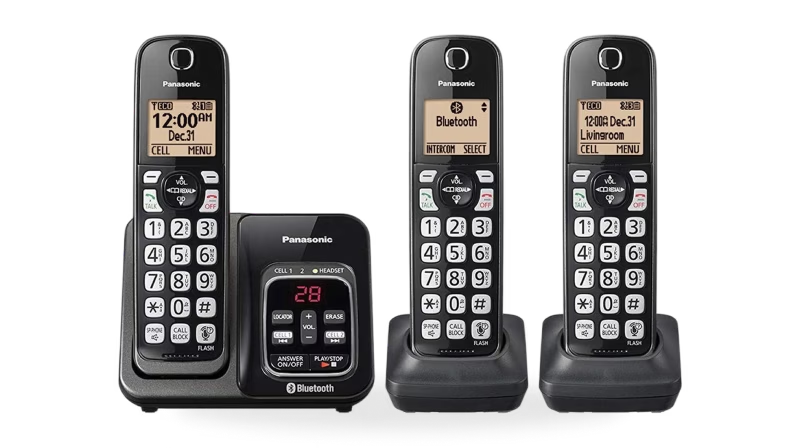
Use existing analog phone
or call (844) 843-4175
MONEY BACK GUARANTEE


Unlimited Phone Service
Keep Your Existing Number
Free Adapter, Free Shipping
No Contracts/Setup Fees
Use Existing Analog Phone
or call (844) 843-4175
MONEY BACK GUARANTEE
Desktop and Mobile App
Email To Fax
Dedicated Fax Number
Easily Fax Documents
No Contracts/Setup Fees
or call (844) 843-4175
MONEY BACK GUARANTEE
Flexible Plans
Everywhere Connectivity
High-Speed Internet on the Go
Reliable Internet Connection
Easy Setup and Access
or call (844) 843-4175