Most small-business phone problems don't start as problems. They start as workarounds. You use a personal cell phone because it's convenient. You let calls roll to voicemail because you're with a customer. You promise yourself you'll fix the after-hours situation later.
Then one day, you realize you're losing opportunities in ways you can't track. A new lead calls once and moves on. A repeat customer reaches the wrong person and gives up. Someone leaves your team, and your system leaves with them.
A VoIP small-business phone service helps you avoid these missed opportunities by providing a cleaner, more structured system. Through smarter call handling, you can achieve flexibility that doesn't depend on any single device or employee.
Mistake 1: Running the Business on a Personal Cell Phone
Using your personal number feels efficient,especially when you're starting out. The downside shows up later. Customers start texting you at odd hours. You can't easily hand off calls. You hesitate to answer unknown numbers because you're flooded with spam. If you switch phones or carriers, your business line gets tangled up in your personal life.
VoIP separates your business identity from your personal device. You keep a business number that stays yours, and you can answer it from wherever you work. If you hire help, you don't have to hand them your personal phone or ask them to use theirs. Instead, you're building a system that belongs to the business.
Mistake 2: Missing Calls When You're Busy
This is the most common mistake because it's the most human. You have many responsibilities, and when calls come in, you can't always answer them yourself.
The fix isn't "try harder." The fix is call handling that matches your reality. VoIP gives you access to tools like ring groups and call forwarding. Instead of having one person carry the entire load, you route calls to the right place by default. When you're slammed, your phone system still behaves like you're organized.
As an example, if you run a home services business, you can route new leads to whoever is free while sending existing clients to their respective coordinators. It's a simple process that reduces the back-and-forth that causes people to hang up.
Mistake 3: No Clear After-Hours Plan
After-hours calls can be valuable but difficult to catch. Without a plan, it's all too easy to miss important calls.
A better setup gives callers a clear path.They can leave a voicemail that reaches you quickly, or they can get directed to the right next step. You can set business hours, then create a custom greeting and decide what happens to the call and any messages they leave.
With a clear after-hours plan, the caller experience stays consistent even when you're off the clock. Your business feels professional at all hours without needing a full-time receptionist.
Mistake 4: Losing Control When Someone Leaves the Team
If your phone system is one person's cellphone, you inherit a headache the moment that person leaves or goes on vacation. Customers try calling the same number, and you have to update all your marketing materials with the new one. Meanwhile, dozens of potential business opportunities are already gone.
VoIP keeps the phone system independent of anyone employee. You can easily change where calls end up without changing your public number. That's a quiet advantage until the day you need it. Then it can feel like a lifesaver.
Mistake 5: Call Routing That Depends on Memory
Many small businesses operate on shared knowledge rather than clear protocol. Everyone knows that "if it's a billing question, ask Sam," and "if it's a new quote, send it to Mia." However, if the needed person isn't available, things get messy quickly. The person who answers the phone tries to help, guesses, and the customer ends up explaining everything twice.
VoIP lets you build the routing rules into the system so you don't rely on memory. You can create a simple menu, route by time of day, or just ring a few people at once. These systems can remove excess friction that makes your business feel scattered.
If you want a quick litmus test for your routing, listen for these symptoms:
- Customers frequently ask, "Is this the right number?" and you can hear the doubt in their voice. That usually means your call flow is confusing, even if your team has adapted to it.
- You hear or say, "Let me transfer you" too often. Transfers aren't bad, but repeated transfers signal that calls are landing in the wrong place first.
- The same customer repeats the same story to two or three people. That's time you're paying for and patience they won't always have.
Mistake 6: Treating Voicemail Like a Dead End
Voicemail is useful when it's part of a system. It's a problem when it's a black hole. If messages live on one handset,you can't share them. If someone forgets to check them, you'll miss important calls.
VoIP voicemail tends to be easier to track and share. Messages from each of your lines can be delivered to a single dashboard,reducing the "I didn't see it" problem. You also get a clearer trail when you're following up with leads or responding to customer issues.
Mistake 7: Pricing That Punishes You for Growing
A lot of small businesses get stuck with phone service plans that feel fine at 5 people but painful at 10. Once you start adding lines, you get hit with sudden fees, or end up paying for features you don't use because they're bundled into a contract you can't change.
VoIP is often a better match for businesses that grow in steps. You can scale users and features without rebuilding your whole setup and adjust how calls route as your team changes. That level of flexibility protects your time and your budget.
What a Good Phone System Feels Like Day to Day
When your small business's phone services are working, they fade into the background. Calls go to the right person more often. Messages don't get lost.After-hours is handled with intention. Your personal phone stops being the business's front door.
You'll still have busy days. You may still miss a call sometimes. The difference is that your system is designed to catch what you can't, keeping your business reachable without relying solely on your availability.
If you're mapping your next steps, start simple. Identify where calls get lost, where ownership is unclear, and where your number is tied to an individual rather than the business. From there, you can build a VoIP setup that supports growth without adding complexity.
Video
Infographic
Small businesses often rely on temporary phone fixes that become long-term frustrations. VoIP creates a more organized system by separating personal and business calls, keeping your company professional and reachable. This infographic reveals common phone mistakes VoIP helps prevent.

MONEY BACK GUARANTEE

SMS to Email
Announcements
Voicemail to Email
Call Forwarding
Toll Free / Vanity Number
or call (844) 843-4175
MONEY BACK GUARANTEE
Free Desk Phone
Desktop & Mobile Apps
Local and Toll Free Numbers
Voicemail to Email
Text Messaging
Unlimited Calling
or call (844) 843-4174
MONEY BACK GUARANTEE

No Apps. No Texts. No Distractions.
No Strangers Allowed
Quiet Time Protected
Unlimited Calling
Emergency-Ready
or call (844) 843-4175
MONEY BACK GUARANTEE
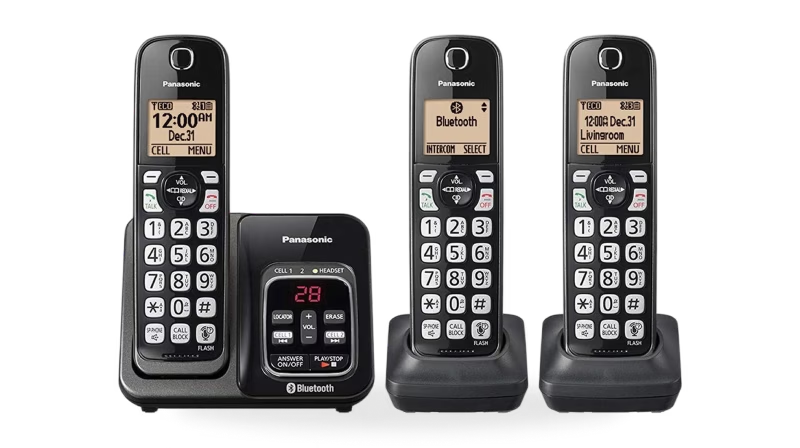
Unlimited phone service
Keep your existing number
Free adapter & free shipping
No contracts/setup fees
Use existing analog phone
or call (844) 843-4175
MONEY BACK GUARANTEE


Unlimited Phone Service
Keep Your Existing Number
Free Adapter, Free Shipping
No Contracts/Setup Fees
Use Existing Analog Phone
or call (844) 843-4175
MONEY BACK GUARANTEE
Desktop and Mobile App
Email To Fax
Dedicated Fax Number
Easily Fax Documents
No Contracts/Setup Fees
or call (844) 843-4175
MONEY BACK GUARANTEE
Flexible Plans
Everywhere Connectivity
High-Speed Internet on the Go
Reliable Internet Connection
Easy Setup and Access
or call (844) 843-4175