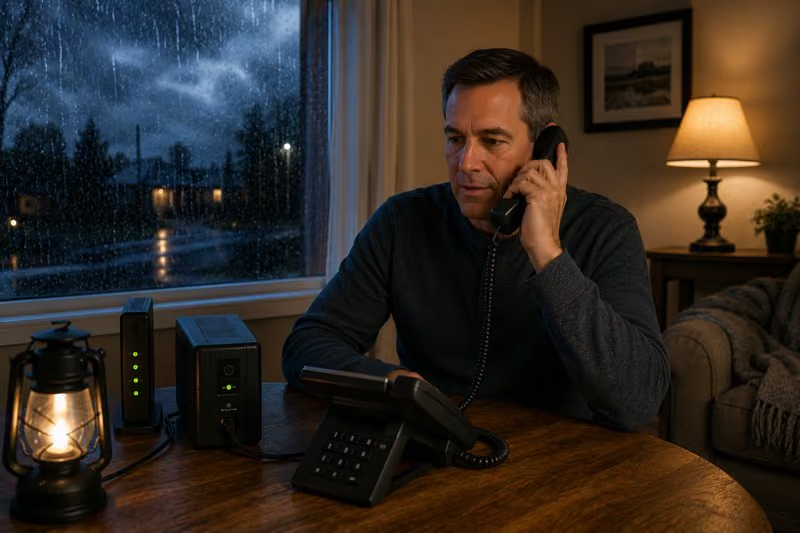
When storms roll in or the power flickers, you want your home phone service to stay useful. That doesn't happen by accident. Reliable service during rough conditions comes from planning, backup options, and a phone setup that can keep working even when one part of the system struggles.
A lot of people still think that having a reliable home phone service means that the service should never fail. A better standard is resilience. You want calls to keep moving or quickly fall back to another option when conditions get messy. That kind of resilience becomes especially valuable during storms and localized service interruptions.
If you rely on a home phone for anything from family contact to medical calls, it helps to know what actually makes service more dependable when the weather turns.
Assumptions About Older Phones Don't Always Hold Up
For years, people assumed a traditional phone line was the safest option during a storm. That idea came from a time when older landline systems had a reputation for staying active during outages. Today, the picture is more mixed.
Many households no longer use the same kind of legacy phone setup. In many cases, copper networks are reaching the end of their service life. As a result, service interruptions can be more common. Repairs can take longer, and the infrastructure itself may be less dependable than it once did.
That is why it helps to stop thinking in terms of one type of system being safer and start looking at how the current service is built. Modern reliability depends on using backup paths and smarter routing to create a system that can adapt when one component fails.
Redundancy is What Keeps Calls Moving
The strongest home phone service has built-in backups. If one route fails, another route can carry the call. That is the basic idea behind redundancy.
In practice, redundancy often means the service has multiple paths to keep calls moving when part of the network encounters trouble. For instance, some VoIP home phone service providers use distributed network infrastructure that can help calls recover more smoothly if one area experiences problems. Some systems also support geographic failover, which allows service to shift away from a local outage and continue through another part of the network.
You don't need to manage most redundancies yourself. The key is choosing a service that was designed with those fallback options in mind. When conditions are unstable, that extra layer can make the difference between a dropped connection and a call that still gets through.
Your Equipment is Just as Important as Your Network
A reliable phone setup depends on more than the provider. Your equipment inside the home matters too. If your modem and router lose power, your phone service may stop, even if the wider network remains operational.
You can build redundancy into your own equipment using tools like a battery backup. A backup power source for your modem and router can keep your service active through short outages. If the power drops for a brief period, your phone may remain usable long enough to handle important calls.
This is one of the simplest ways to improve resilience at home. You're giving the system more time to stay up instead of letting a small outage shut everything down immediately.
Call Forwarding Adds a Safety Net
Call forwarding provides an additional layer of protection. If your home phone is interrupted or you're away, forwarding can send calls to your cell phone so you stay reachable.
That becomes especially useful during storms and other local outages. You may lose part of your home setup, but you don't lose every incoming call. For many households, that backup is enough to reduce a lot of stress.
Reliable Service Recovers Faster
The strongest systems aren't necessarily the ones that never experience problems. They're the ones that recover quickly and keep small disruptions from turning into long outages. During storms or local outages, even strong networks can experience interruptions. The difference then becomes whether the service can reconnect smoothly or whether a minor disruption becomes a long communication gap.
That is where modern network design can help. Some systems are built to restore connections more quickly or shift calls away from affected areas while the problem clears. In practice, that can mean the difference between a brief interruption and a phone that stays down for hours after conditions improve.
A short weather event or a local power issue doesn't always require perfect uptime to remain manageable. Often, the more important factor is whether the service can stabilize quickly enough to keep communication from breaking down completely.
What to Check in Your Own Setup
If you want your home phone to hold up better during outages or rough weather, focus on a few practical steps:
Check whether your modem and router have battery backup or whether you could add it.
Short outages can often be mitigated, at least partially, with backup power.
Review whether your phone service supports call forwarding to a mobile phone.
This gives you a clear fallback if your main setup goes offline.
Look at how your provider handles network disruptions.
Broader routing support and built-in failover can improve service stability when local conditions are poor.
Remember, you don't need a perfect system. You need a system with enough backup to keep communication going when things stop being ideal.
Reliability Comes From Backup, Not Luck
A dependable home phone service during power or weather issues is built around preparation. Reliable service uses stronger network design and practical fallbacks like battery support and call forwarding to make the service more resilient when your area hits a rough patch.
If you're reviewing your current setup, identify your weak points now. A short outage shouldn't cut off every option at once. A storm shouldn't leave you guessing whether anyone can reach you. With the right support in place, your home phone service can stay far more useful when you need it most.
MONEY BACK GUARANTEE

SMS to Email
Announcements
Voicemail to Email
Call Forwarding
Toll Free / Vanity Number
or call (844) 843-4175
MONEY BACK GUARANTEE
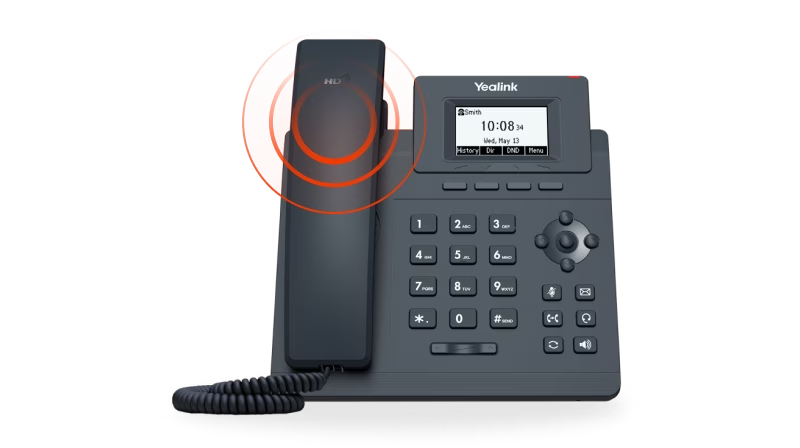
Free Desk Phone
Desktop & Mobile Apps
Local and Toll Free Numbers
Voicemail to Email
Text Messaging
Unlimited Calling
or call (844) 843-4174
MONEY BACK GUARANTEE

No Apps. No Texts. No Distractions.
No Strangers Allowed
Quiet Time Protected
Unlimited Calling
Emergency-Ready
or call (844) 843-4175
MONEY BACK GUARANTEE
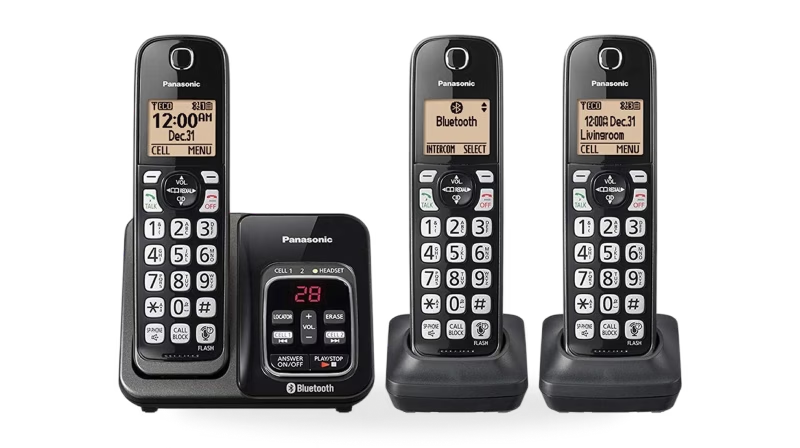
Unlimited phone service
Keep your existing number
Free adapter & free shipping
No contracts/setup fees
Use existing analog phone
or call (844) 843-4175
MONEY BACK GUARANTEE

Unlimited Phone Service
Keep Your Existing Number
Free Adapter, Free Shipping
No Contracts/Setup Fees
Use Existing Analog Phone
or call (844) 843-4175
MONEY BACK GUARANTEE
Desktop and Mobile App
Email To Fax
Dedicated Fax Number
Easily Fax Documents
No Contracts/Setup Fees
or call (844) 843-4175
MONEY BACK GUARANTEE
Flexible Plans
Everywhere Connectivity
High-Speed Internet on the Go
Reliable Internet Connection
Easy Setup and Access
or call (844) 843-4175